NEET for the Economically Weaker Section (EWS)
The EWS in NEET is an important provision for reservation of candidates belonging to the Economically Weaker Section (EWS) of the unreserved or general category.
Eligible EWS candidates can get the benefit of reservation during the process of medical counselling to allocate their seats in the colleges in the Economically Weaker Section (EWS) category.
NEET (National Eligibility Entrance Test) is a common entrance test that is conducted by NTA(National Testing Agency) for undergraduate medical students in India. After the examination, admissions take place through the relevant counselling authorities. For AIQ (All India Quota), the MCC conducts counselling for eligible undergraduate medical seats. There is only a 10% EWS reservation applicable in AIQ seats.
What is the EWS Category in NEET?
The answer to the question: What is the EWS category in NEET? is that EWS stands for Economically Weaker Section. In the context of NEET or any other academic counselling, EWS is a reservation category intended for eligible candidates who are not covered under the specified SC, ST, or OBC reservation category under the applicable central framework and who satisfy the prescribed economic and asset conditions.
The EWS category is therefore different from simply being a general-category candidate.
A candidate can belong to the general category but may not be eligible for EWS (Economically Weaker Section) reservation. To claim general EWS (GEN-EWS) status, the candidate must fulfill the prescribed requirements.
The EWS framework was introduced to provide reservation based on economic criteria to eligible persons outside the existing SC/ST/OBC reservation framework. An annual family income limit of below ₹8 lakhs, along with prescribed restrictions on property ownership, according to the Government of India’s EWS guidelines.
Is EWS Applicable for NEET?
Many questions arise in the minds of aspirants, especially those students who have a background in the General category or EWS category; i.e., is EWS applicable for NEET?
The answer is YES; EWS is applicable for NEET. According to MCC (Medical Counselling Committee) reports or its database, it is clear that 10% EWS reservation applies to AIQ seats in NEET.
It is important to know that EWS is not a different category for the NEET examination. EWS candidates can apply and appear for the same NEET UG examination as other candidates.
The category criteria plays a major role during the admission and counselling process, in which candidates compete for seats according to the applicable reservation and seat allotment rules.
The steps to follow for seats allocation in a medical college are listed below:
- Firstly, candidates should appear in the NEET UG examination.
- The ranking of a particular candidate must be equal to or higher than the cutoff.
- After satisfying the ranking criteria, candidates are eligible for the counselling process.
- The medical college will verify your category during the admission process.
- A seat will be allotted after this process is complete.
Therefore, scoring well in the NEET examination remains essential even for candidates from the EWS category.
EWS Eligibility Criteria for NEET
According to EWS rules, the EWS eligibility for NEET is determined for the central EWS framework. The major conditions include: -
- The family should satisfy the prescribed asset and property conditions.
- The total annual family income should be less than ₹8 lakh.
- The candidate should not fall within the specified SC/ST/OBC categories which are covered by the central reservation framework.
- The candidate must produce the required income certificate in the prescribed format whenever required.
- The most important thing to note is that the ₹8 lakh condition should not be treated as the only EWS requirement.
An aspirant whose family income is below ₹8 lakh can still be ineligible if the family's combined properties exceed the government’s asset limits.
EWS Criteria for NEET
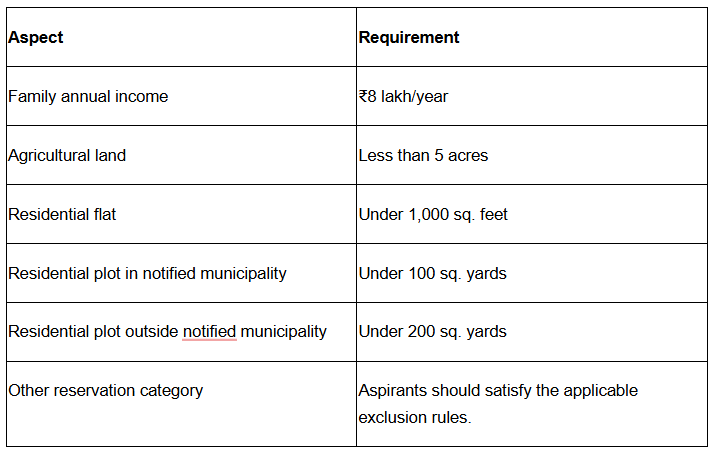
The EWS criteria for NEET depend upon the family annual income, residential land, and other reservation categories, as mentioned below:
What Income is Considered for EWS?
As mentioned above, for Economically Weaker Section (EWS) reservations in India, the gross annual family income must be below ₹8 lakh.
This total income includes earnings from all sources, mentioned as:
- Agriculture
- Business
- Profession
- Salary
- Other sources
So, the family should calculate their overall family income by using the applicable rule passed by the Government of India rather than considering only the student’s income or a parent’s salary.
Who is Considered Family for EWS?
There are other questions arising related to the EWS in NEET, like, who is considered family for EWS?
The EWS evaluation not only considers the individual income and assets of aspirants. This is applicable when considering specified income sources of family members with their relevant assets to check their genuine family income and determine whether the candidate is eligible for an EWS certificate or not.
These are some important things to consider during assessment:
- Plots
- Family income
- Agricultural land
- Residential property, property held in different locations
For that, aspirants should carefully check the complete family income and property details before applying for an EWS certificate, which is beneficial for the student in their future.
General EWS in NEET
Many students are wondering about the difference between the general category and EWS.
Alongside this, students want to know whether EWS is different from the general category or not.
So, here is your answer about General EWS in NEET: it means an eligible candidate from the general or unreserved category who qualifies for EWS reservation; they can apply under the EWS category for the medical entrance examination.
Therefore, the General category and a low-income source cannot automatically be EWS in NEET; all required prescriptions and details must be fulfilled.
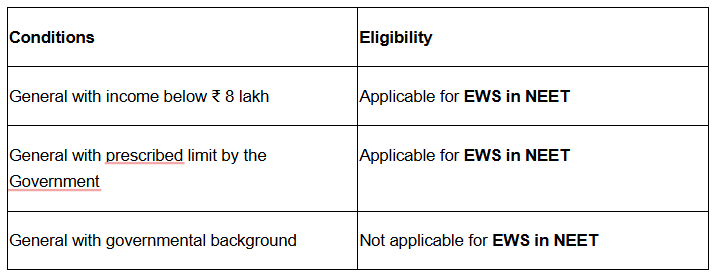
The candidates eligible for EWS in General category are as listed below in the table:
The major benefits of EWS in NEET are mentioned below, which aspirants should go through before applying.
- 10% EWS in NEET Reservation in Applicable AIQ seats:
According to the MCC reports, the most significant benefit is the 10% EWS reservation in the applicable All India Quota (AIQ) seats. The 10 % EWS (Economically Weaker Section) reservation means medical colleges set aside 10 % of their available seats specifically for eligible EWS candidates from lower-income and with general category backgrounds that full the other criteria too
So, if a candidate wants admission in a medical college with an EWS certificate, then their competition may be a little easier than for other candidates in the general category; still, they face major competition within their category for ranking and seats.
- Opportunity to Compete for EWS-Reserved Seats:
An eligible candidate not only competes with EWS candidates during counselling but also with others in the band of the seat allotment process, and their marks should be equal to or slightly higher than those of others belonging to the NEET examination; due to the high number of candidates in the same category can also become competition in the medical examination with the best category and best marks. So, on the safe side, you should have good marks in this category, which can offer you the best medical college with the best opportunity at the lowest fees.
- Reservation can Improve Admission Opportunities:
Yes, reservation provides a great opportunity to get admission into a medical college. In fact, it can help you get into one of the best medical colleges. However, reservation is not the only factor for getting into a medical college; you still need to meet several other eligibility criteria. It can provide an additional route to admission compared to other unreserved candidates.
Also, reservation does not guarantee admission. A candidate still needs an excellent competitive NEET rank and must participate correctly in counselling.
- Benefits Depending upon the Applicable Quota
The benefit depends on the applicable quota and whether the candidate is applying through:
- All India Quota
- State Quota
- Central Institution Counselling
- Other applicable counselling system
One thing is important: every candidate must know that state-specific reservation policies may differ from other reservation policies, so candidates should first consult the counselling authority for their state.
What is the EWS Quota in NEET?
The EWS quota in NEET refers to the reservation applicable for medical seats for eligible EWS (Economically Weaker Section) candidates.
For the central AIQ framework, the EWS reservation is 10%, as mentioned above MCC confirmed officially that this reservation applies to AIQ seats.
The most important thing students must know is that the EWS quota does not mean that 10% of every medical seat in India is automatically an EWS seat in NEET; every college may have its own policy.
The quota applicable, eligibility criteria as per government for the seat allocation and number of students applied for that category must also be considered.
EWS Seats in NEET: How Are They Calculated?
The number of EWS seats in NEET changes every year because the total number of seats in the medical entrance examination varies.
It can be affected by:
- Institute category
- AIQ conversion rules
- Institutional category
- New medical college
- Increase in MBBS seats
- Additional or withdrawal seats
- Counselling-specific seat distribution
Therefore, there is no permanent number of seats for EWS in the NEET examination.
MCC has provided the relevant counselling information and EWS seats for the upcoming admission session. The MCC UG counselling portal provides new and fresh counselling details for the upcoming session.
Simply, it can be calculated as if a particular medical college has a seat pool of 1,000 seats and, according to the EWS reservation in NEET, which is applied as 10%, the EWS must have 100 seats out of 1,000 seats.
However, the actual medical college seat allotment may be or may not be different from this practical data; it must be based on the official seat allocation and availability, not a simple calculation which is made by the aspirants.
NEET EWS Certificate
A NEET EWS certificate usually refers to the Income and Assest Certificate, which has a prescribed income limit and the eligibility criteria for the certificate of EWS in NEET.
It is crucial for students who want to claim EWS in NEET reservation and get help with this if the counselling authority accepts it.This certificate has a prescribed income limit. The competent authority issues this certificate under the prescribed relevant government rules.The candidates can apply for EWS in NEET through service provided on the government portals. Also, the exact process of application may vary from state to state and among Union Territories. The portal of the individual state’s competent authority may specify its own procedure for application of certificate.
How to Make EWS Certificate for NEET?
After the question EWS eligibility for NEET a candidate generally wants to know what is this certificate about? NEET EWS certificate generally refers to the prescribed income and the certificate used to establish EWS eligibility. This is an important document for candidates who wants to claim EWS reservation during counselling or admission to any medical college. Candidates who want to know how to make an EWS certificate for NEET must follow the process that is governed by their state authority or their competent authority.
A basic process to apply for the EWS certificate is described below:
Step 1: Verify Eligibility
For verification of eligibility, you should check your family’s background, such as
- Residential income
- Residential plot
- Agricultural land
- Annual income
- Applicable category status
Step 2: Collect all of your documents
Original documents are required in different states, and aspirants should have all of their original documents because requirements can be changed from state to state; candidates may be asked for documents for EWS , such as;
- Identity proof
- Address/residence proof
- Income documents
- Photographs
- Family details
- Self-declaration
- Property/land records
- Other documents specified by the issuing authority
As we know, government EWS services can require residence proof, photo identity, and self-declaration.
Step 3: Submit the application
You should apply through the relevant government portal, website, or designated competent authority.
Step 4: Verification
The relevant authority for EWS certificate verification must verify the documents of candidates, including family income, information, and assets.
Step 5: Receive the Certificate
After checking all information, it is approved, and then the EWS income and asset certificate is issued.
Candidates have to check the certificate carefully for:
- Name
- Category
- Certificate number
- Issued date
- Financial year
- Issuing authority
- Signature
- Other required particulars
For EWS reservation in NEET, it is important to know that some basic certificate criteria are changing from state to state.
How to Apply for the EWS Quota in NEET?
Several EWS NEET aspirants want to know how to apply for the EWS quota in NEET; this process involves both category declaration and counselling.
Step 1: Obtain the Appropriate Certificate
Candidates have to start their certificate process four or five months before counselling; they should not wait until the final counselling round because sometimes these processes take too much time for a small document verification.
Step 2: Enter Category Information Correctly
During the process of submitting the EWS in the NEET application form, candidates should properly check the information that is filled by them, and they have to be more careful about their category details according to the instructions that are applicable for that year.
Step 3: Preserve the Certificate
Most importantly, candidates must keep all of their original documents with them, as well as digital copies, safely.
Step 4: Register for Counselling
For counselling, eligible candidates participate through MCC’s counselling system. MCC offers counselling criteria for undergraduate medical course seats.
Step 5: Submit/Verify Documents
Candidates have to submit the original copies of their documents, as well as the original copy of the EWS certificate in NEET , which is valid for that year, not any other expired year certificate of EWS in NEET, and they have to follow the counselling authorities' instructions regarding EWS certificate submission and verification.
Step 6: Fill choices carefully
After all verification, if a candidate has been allotted a seat in a medical college, candidates participate in choice filling and seat allotment according to the counselling schedule.
EWS Reservation in NEET: AIQ vs State Quota
The difference between AIQ and state EWS Reservation in NEET quota is one of the most important aspects that students must know. How can a student apply for the AIQ quota and how is it different from the state quota? How will students become eligible for both the quota? The details for the questions are given below, as mentioned below:
All India Quota:
In this category, MCC confirms that 10% EWS in NEET reservation applies to AIQ seats.
In this quota, candidates should not assume that the same EWS in NEET rule, seat distribution, or certificate format applies identically in every state because state counselling authorities administer state quota admission only according to the reservation rule which is applicable in that state.
The best option is for state counselling: always check the official notification and seat allocation criteria issued by the respective authority during counselling.
EWS NEET Cutoff: Qualifying vs Admission Cutoff
There is no doubt that it is tough to understand the EWS NEET cutoff, it becomes confusing because it is used in two different ways and for different things.
- Qualifying Cutoff
Qualifying cutoff stands for the minimum marks or percentile a candidate needs to qualify for NEET.
- Admission cutoff
The admission cutoff stands for the actual cutoff of a medical college that candidates have to meet to obtain a seat in a particular college with their course during the time of counselling.
An important thing to know is that these two cutoffs should never be treated as the same.
Simply, we can say that a candidate can qualify NEET, but still she/he will never obtain an MBBS seat because of the admission cutoff criteria.
EWS Cutoff for NEET Previous Year 2026
For EWS seats in NEET, the EWS previous year cutoff can help students to estimate the upcoming cutoffs. According to NEET UG 2026, the general EWS category had a 50th percentile qualifying requirement, which has a marks range of 715-213.
This means 213 was the last or lower qualifying marks range for EWS /General category in NEET UG 2026, but yes, as we mentioned above, it is not sure that these are sufficient marks to secure an MBBS seat.
For students preparing for NEET 2027, the cutoff cannot be predicted before the exam because the actual admission EWS cutoff for NEET depends on some factors such as:
- AIQ or state quota
- State
- NEET rank
- College
- EWS seat availability
- Counselling round
- Number of candidates
- Choice filling
- MBBS/BDS courses
NEET results and rank information are published by NTA on its official website through its official NEET portal.
How Many EWS Candidates were in NEET 2026?
The frequently asked question is: “ How many EWS candidates were in NEET 2026?”
As per the official NEET UG 2026 result documentation, this distinction is important: registered, appeared, and qualified candidates are figures.
The article is published on the official website of NTA (National Testing Agency), which is category-wise.
In NEET UG 2026, a total of 1,65,573 EWS in NEET candidates registered, 1,53,693 candidates appeared for the exam, and 95,026 qualified.
EWS Reservation and NEET Rank: How does it Affect Admission?
EWS reservation never affects the NEET rank. A candidate's admission totally depends upon the candidate's marks, rank, available seats, choice preference, and counselling rules.
This is the reason that’s why students have not considered the statement that EWS candidates can get admission at 213 marks only in an MBBS college, because there is a large amount of competition among EWS candidates in NEET and also with other candidates.
That would be misleading; the previous year (2026) mark was 213, which is the qualifying cutoff, but not the admission cutoff. So, now it would be clear that admission may get affected if you get confused between EWS reservation and NEET rank.
Documents Required for EWS Counselling
The document required for EWS counselling are as follows:
- NEET admit card
- NEET scorecard/result
- Class 10 certificate
- Class 12 certificate/marksheet
- EWS income and Asset certificate
- Valid identity proof
- Domicile certificate, where applicable
- Passport-size photographs
- Counselling registration documents
- Other certificates required by the relevant authority
The candidate should go through the updated MCC/state counselling notification rather than anything else because the exact document list can change according to the counselling authority.
Common Mistakes EWS Candidates Should Avoid
There are some common mistakes which every NEET aspirant of EWS category should avoid that are as follows:
- Until counselling, candidates should check the requirements in advance.
- Using an incorrect certificate
- Assuming income below ₹8 lakh is enough
- Confusing qualifying cutoff with college cutoff
- Confusing general and general- EWS
- Ignoring state-specific rules
- Providing incorrect information
EWS in NEET: Key Points for Students
Some key points that are important in NEET are given in the table below:
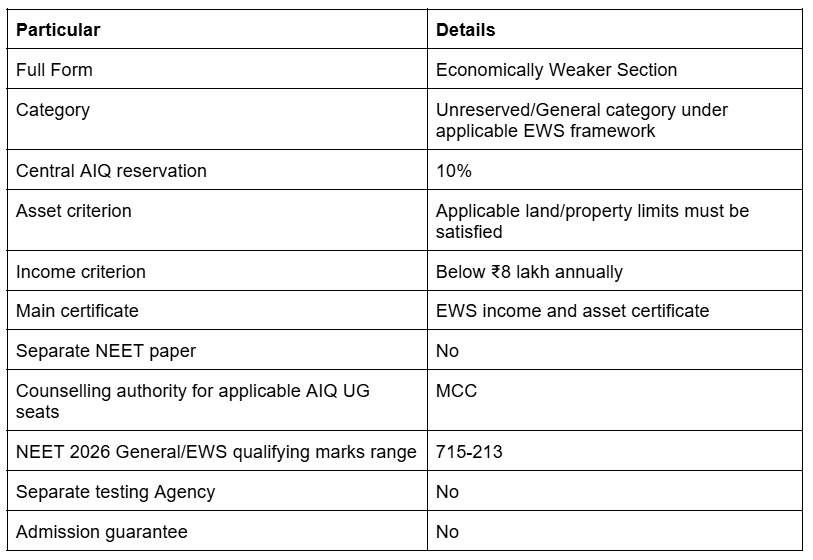
So, 10% EWS AIQ reservation is confirmed by MCC, but it can not be said with certainty that medical college admission is guaranteed under EWS in NEET.
But you have to improve yourself with perfect self-study and guidance; for that, PrepMed is one of the affordable options for NEET aspirants, especially those who belong to General-EWS in NEET.
Conclusion
Understanding EWS in NEET is important for candidates who belong to the general category but whose income source is not as good as other candidates and even if they do not fall under any reserved category can get the benefits of EWS category criteria that can help them during their counselling in medical college.
Along with meeting the eligibility criteria, the student should also focus on preparation for the upcoming NEET exam 2027. Students should prepare under the right guidance. PrepMed offers NEET-based study material and classes in offline and online modes. So, candidates looking for structured study material and expert guidance for NEET 2027 can explore the courses offered by PrepMed coaching because it provides structured learning and quality education at an affordable price.
Also read:
West Bengal State Quota cut off for Re-NEET 2026
What is State Quota in NEET and How to Apply for It?
Counselling and Reservation for Admission to Different Medical Courses under NEET - 2026 update
Recent Posts
Explore the PrepMed NEET 2-Year Courses List

West Bengal GMC Round Cutoff Prediction for NEET 2026 | YouTube Live
All India Quota Medical College List 2026: MBBS Course

List of MBBS Colleges in Jharkhand: Seats and Process
NEET for the Economically Weaker Section (EWS)