
Difference Between JEE Main and JEE Advanced
Many students find it hard to understand the difference between JEE Main and JEE Advanced, as most websites show numbers without explaining them.
That is a problem, because these two exams are not simply an easy version and a hard version of the same test. Different bodies run them, they open different doors, and they ask you to think in different ways.
If you are in Class 11 or 12 and still unsure how the two exams connect, this guide explains it in simple language.
By the end of this blog, you will know who conducts these JEE Main and JEE advanced exams, which students are eligible, what the exam paper looks like, and where your rank can actually take you.
Check out: Best JEE Coaching in Kolkata, India
What Is JEE Main and Advanced? A Simple Overview
Think of the route as two stages. JEE Main comes first. JEE Advanced comes second and is open only to candidates who meet its eligibility conditions, starting with a place among the top 2,50,000 successful candidates in the JEE Main B.E./B.Tech. paper.
That link is why students mix the two up. Still, clearing one does not secure a seat. The JoSAA business rules state that qualifying in these exams does not guarantee admission to any institute, because each programme may add its own requirements. Keeping the difference between JEE Main and JEE Advanced in mind from the start makes planning much easier.
The First Stage: JEE Main Explained
So, what is JEE Main?
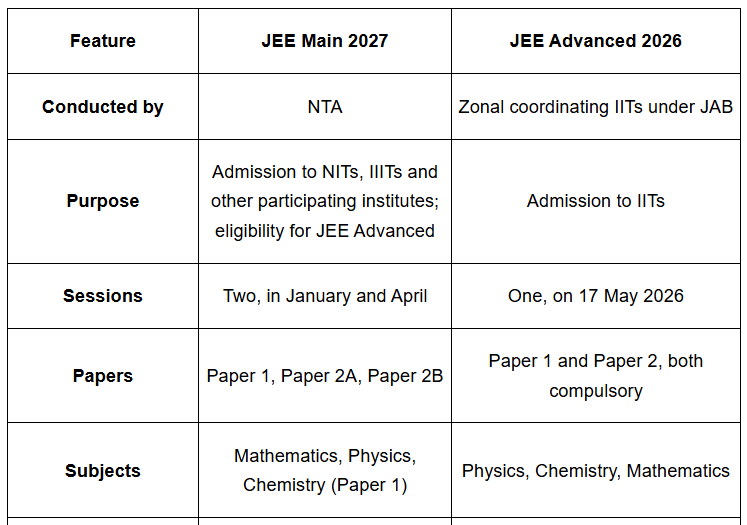
It is the Joint Entrance Examination (Main), conducted by the National Testing Agency (NTA). NTA does not conduct JEE Advanced. According to the NTA bulletin for 2027, JEE Main has three papers: Paper 1 for B.E./B.Tech., Paper 2A for B.Arch. and Paper 2B for B.Planning. Paper 1 is used for engineering admissions at NITs, IIITs, other centrally funded technical institutions and institutions funded or recognised by participating state governments.
JEE Main 2027 is designed in two sessions: 20 to 24 and 28 January 2027, and 2 to 7 April 2027. A candidate may appear in one session or both, and the better total NTA score is used for the rank. This two-session format is another difference between JEE Main and JEE Advanced, since the second exam is held once a year.
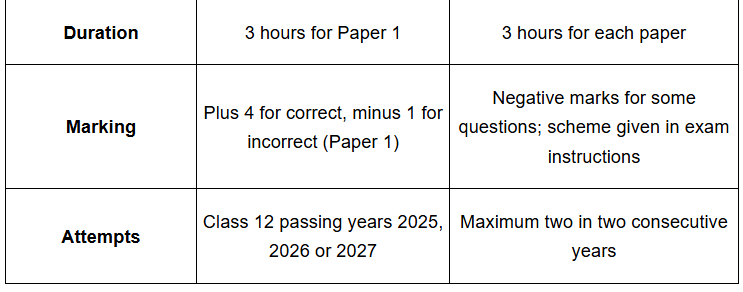
The 2027 Paper 1 pattern is a three-hour computer-based test of 75 questions for 300 marks. Mathematics, Physics and Chemistry each carry 25 questions, made up of 20 multiple-choice questions and 5 numerical-value questions. A correct answer earns four marks, and an incorrect answer costs one mark in both sections.
For JEE Main 2027 no specific age is required. Candidates who passed Class 12 in 2025 or 2026, or are appearing in 2027, can apply, while those who passed in 2024 or earlier cannot.
The Second Stage: JEE Advanced Explained
Now the next question: what is JEE Advanced?
JEE Advanced is the exam for admission to the 23 IITs. The IITs conduct it themselves under the Joint Admission Board (JAB), with one IIT acting as the organising institute each year. In 2026, this role was handled by IIT Roorkee. This is the first major difference between JEE Main and JEE Advanced, as NTA conducts JEE Main.
The 2026 exam was held on 17 May 2026 as two papers of three hours each, and appearing in both was compulsory. Each paper has Physics, Chemistry and Mathematics sections, and the test was computer-based only. The brochure says negative marks may apply to some questions, with the exact scheme shown in the instructions at the time of the exam.
Difference Between JEE Main and JEE Advanced in Eligibility
Two ideas need to be kept apart here: eligibility to appear for an exam, and eligibility for admission afterwards. To appear for JEE Advanced 2026, a candidate had to meet all five conditions in the brochure together:
- Be among the top 2,50,000 successful candidates in the JEE Main B.E./B.Tech. paper, chosen with a category-wise distribution.
- Be born on or after 1 October 2001, with five years of relaxation for SC, ST and PwD candidates.
- You get only two chances at JEE Advanced, and they must fall in back-to-back years.
- Your first Class 12 (or equivalent) attempt should fall in 2025 or 2026, and Physics, Chemistry and Mathematics must have been part of it.
- A student who has already joined an IIT earlier is not eligible, apart from the exceptions given in the brochure.
Admission has its own rules. For IIT admission, the brochure asks for 75% aggregate marks in Class 12 (65% for SC, ST and PwD candidates) or a place in the category-wise top 20 percentile of your board. Admission to NITs and other participating institutes through JoSAA also depends on a Class 12 requirement given in the business rules, along with any institute-specific conditions. Check the document for the year you apply. This split between appearing and admission is a key difference between JEE Main and JEE Advanced, because JEE Main asks only for a Class 12 passing year, while the second exam adds rank, age, attempt and admission-history conditions.
Exam Pattern: The Difference Between JEE Main and JEE Advanced at a Glance
This table sets out the difference between JEE Main and JEE Advanced side by side, comparing JEE Main 2027 with JEE Advanced 2026 from the official documents named above.
Difficulty Level: The Difference Between JEE Main and JEE Advanced in Questions
JEE Main focuses on conceptual understanding, application and accuracy under time limits. With 75 questions in three hours, managing time matters almost as much as knowing the topic.
JEE Advanced generally needs deeper conceptual understanding and analytical problem solving. A single problem may draw on more than one chapter. A Physics question, for example, might combine mechanics with calculus, while a Chemistry question might ask you to reason through a reaction instead of recalling it. These are only illustrations, not fixed question patterns.
Marking depends on the instructions given for each question and each exam, so read them carefully before you answer.
Admission Pathways: The Difference Between JEE Main and JEE Advanced in Colleges
Both exams lead into one counselling process run by the Joint Seat Allocation Authority (JoSAA). JEE Advanced ranks are used for eligible IIT programmes, and JEE Main ranks are used for eligible programmes at NITs, IIITs and other participating institutes.
After the results, you first register on the official JoSAA portal and then fill in your choices of colleges and courses as a separate step. Both are free. In 2026, the window ran from 2 to 11 June; choices had to be locked before the deadline, and seat allocation took place in five rounds. Once a seat is allotted, you accept it online, pick Freeze, Float or Slide, upload documents and pay the seat acceptance fee.
After JEE Main What’s Next? Your Step-by-Step Plan
- Check your result. Check your JEE Main result. If you are among the top 2,50,000 successful candidates and meet all other JEE Advanced eligibility conditions, you can register for JEE Advanced. For registration dates, keep checking the official JEE Advanced website.
- Register on JoSAA. Complete registration, then fill and lock your choices within the window.
- Follow the rounds. Check the portal after each round, because JoSAA does not send separate seat intimations.
- Know CSAB. Some NIT, IIIT and other participating institute seats may still be vacant when JoSAA ends. CSAB fills these through Special Rounds. The JoSAA rules state there is no special round for IITs.
- Check state options. State-level admission rules differ, and not every state accepts JEE Main scores, so read each state authority's notice. Keep the difference between JEE Main and JEE Advanced in mind while you build a realistic list of options.
Preparing for JEE Main and Advanced Together
Start with clear concepts. NCERT books are a good base for Class 11 and 12 topics, but they alone are not enough for either exam, so add regular problem practice.
Since the difference between JEE Main and JEE Advanced lies in depth as much as format, divide your practice time to match both. Official previous-year question papers are the best guide to how questions are framed. The JEE Advanced website also offers mock tests under its resources section. Practise under timed conditions to build speed and accuracy, and review every mistake. If your concepts are strong, moving from JEE Main to JEE Advanced preparation feels far less sudden.
Note: You cannot appear for JEE Advanced without qualifying through JEE Main.
Final Thoughts
Identifying the difference between JEE Main and JEE Advanced allows you to set realistic goals. As rules may vary from one year to another, please refer to the official announcements before applying. Understanding the difference between JEE Main and JEE Advanced also ensures that you stay focused on what really matters in your preparation.
With PrepMed, strengthen your understanding of Physics, Chemistry and Mathematics, practise strategically and move closer to your JEE goals.
Also read
Recent Posts
Difference Between JEE Main and JEE Advanced

PrepMed Introduces the Best JEE Coaching in Kolkata

List of top best medical colleges in Odisha

PrepMed NEET Computer-Based Test (CBT)

PrepMed Featured on Guwahati Plus