
How to get admission in MBBS in government colleges: cut off and strategy
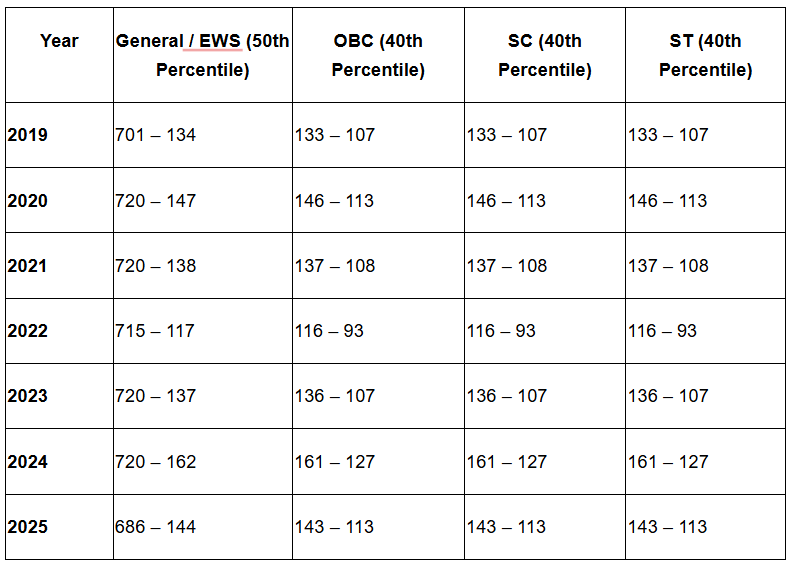
Securing a seat in a government medical college through NEET is difficult because of the stiff competition. If you are wondering how to get admission in MBBS in government colleges, you must consider the NEET cutoff of all the categories. The cutoff marks in NEET depend on a number of factors, such as the difficulty of the exam, the availability of seats, and the rules of reservation for various categories. In order to proceed with the admission process, candidates must obtain at least the qualifying cutoff marks for their category. This is usually in the 50th percentile for the General and 40th percentile for reserved students.
Becoming a doctor is both exciting and challenging, and if you are willing to take admission into a government MBBS college, the path ahead might appear frightening. However, with a clear preparation strategy and understanding, you can definitely get admission to MBBS in government colleges. Find out how many marks you need in NEET to enter into government medical colleges and per category. At the end you will not only know how to get admission in MBBS in government colleges, but you will also be motivated to give your best.
Marks required in NEET for MBBS in government college
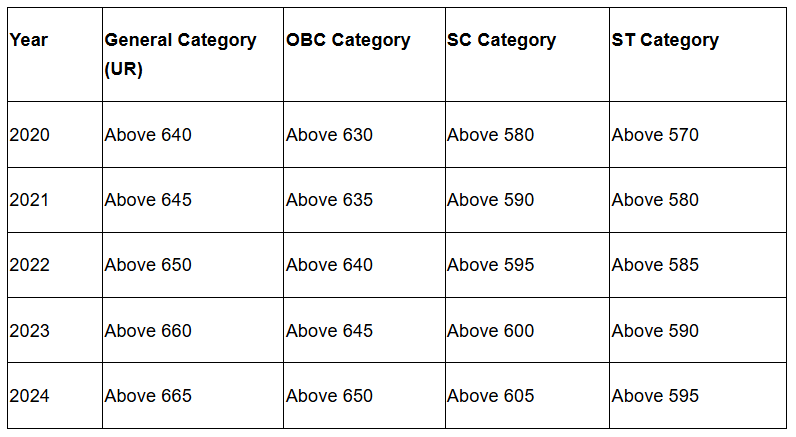
One common question that is asked by the NEET 2026 aspirants is: How many marks are required in NEET for MBBS in government college? You should know that simply scoring the NEET passing marks does not ensure you a seat; you must score much higher and better to get into one of the best government medical colleges.
Detailed Marks Breakdown Based on Category (Previous Years):
Fees for MBBS in government college
Fees for MBBS in government colleges are generally much lower compared to private institutions, making them affordable for a larger number of students. In India, government colleges are subsidized by the central or state governments, so students usually pay only tuition fees, hostel charges, and other basic expenses. The annual fees can range from a few thousand rupees to around one lakh rupees, depending on the state and college. Additional costs may include books, examination fees, and living expenses. Overall, government medical colleges provide quality education at a reasonable cost.
List of Top MBBS Colleges with Their Annual Fees:
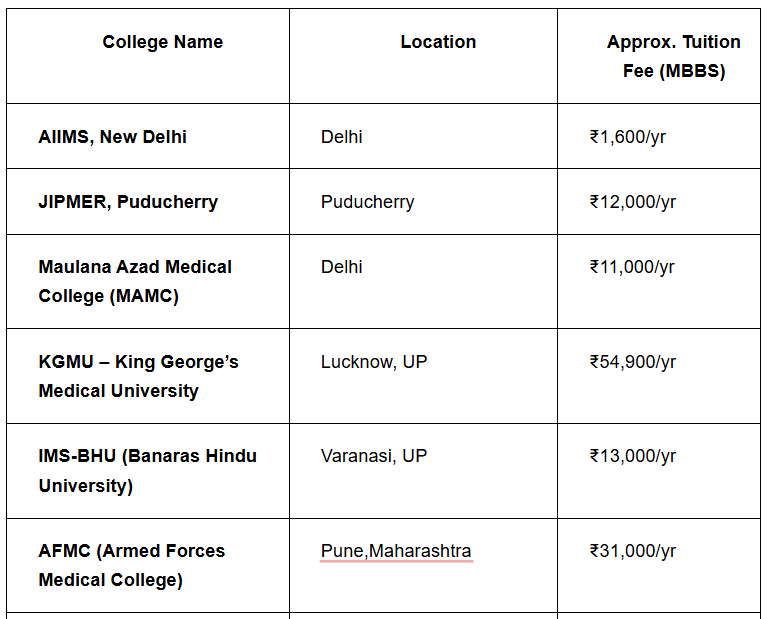
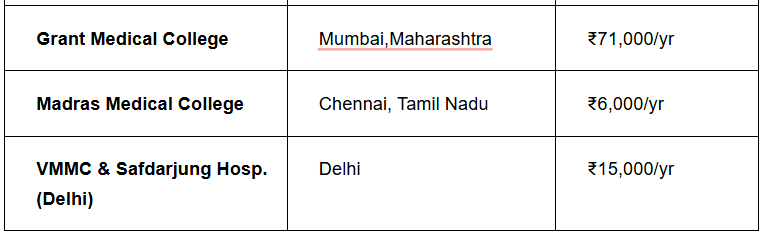
The range of MBBS fees after clearing NEET in government college is around Rs. 6000 to Rs. 1 lakh or more per year. The best government MBBS colleges in India include AIIMS Delhi, MAMC, IPGMER, AFMC, AIIMS Bhopal, AIIMS Rishikesh, etc. The fee structure of the government medical colleges ranges from a few thousands to Rs. 1 lakh per annum whereas the fee in the private medical colleges is very high, even in crores. India has approximately 350-360 government medical colleges that offer low fees of MBBS.
To obtain admission in an MBBS course in the top government medical colleges in India, you should achieve great scores in NEET UG exam. The cost of MBBS in government medical colleges is affordable. There is a high demand and competition for government medical college seats. Typical MBBS fees in government medical colleges cost between 8000 and 35000 per annum.
MBBS cut off for government colleges
The cut-off for NEET is the lowest score or percentile which one must secure in order to secure admission in government medical colleges in MBBS/BDS courses. According to the National Testing Agency (NTA), the cut-offs are released in terms of percentile ranks and not on actual scores:
General/ EWS applicants - 50th percentile (approximately 144 marks out of 720)
SC/ST/OBC - 40th percentile (approximately 113 marks out of 720)
Candidates who do not pass the MBBS cut off for government colleges are not considered in the merit lists. The cut-offs are used to shortlist candidates before the counselling and admissions. The cut-off is calculated after the examination through a process of normalisation that considers the difficulty level of the exam as well as the performance of candidates during that year.
How to score good marks in NEET?
Learning how to score good marks in NEET will help you design a strategic and realistic timetable during your preparation. NEET doesn’t require random hard work; it rewards smart, consistent effort. A clear timetable, a strong NCERT base, and regular practice can dramatically improve scores.
For anyone serious about how to get admission in MBBS in government colleges, NEET preparation must be treated like a gradual journey. Some days will be tough, but discipline will carry you through.
Smart NEET Preparation Strategies
- Understand the NEET Exam Structure
NEET consists of 180 MCQs from Physics, Chemistry, and Biology, carrying a total of 720 marks. Each correct answer gives 4 marks, so accuracy and smart attempt strategy are essential. - Give Equal Importance to Chemistry
Chemistry carries 180 marks and can significantly impact your rank. Focus on NCERT books, practice numerical problems in Physical Chemistry, learn reaction mechanisms in Organic Chemistry, and memorize trends and facts in Inorganic Chemistry. - Practice MCQs Daily
Regular MCQ practice strengthens concepts and improves speed. Aim to solve at least 30-40 MCQs per subject daily and 80-100 Chemistry MCQs to build confidence and accuracy. - Take Mock Tests Seriously
Mock tests simulate the real exam environment and improve time management. Attempt topic-wise tests during the week, subject tests on Saturdays, and a full-length NEET paper every Sunday. - Revise with a Planned Strategy
Revision is key to retention. Follow the 3-2-1 rule: revise after 3 days, practice again after 2 weeks, and test yourself after 1 month under exam conditions. - Adopt Toppers’ Study Habits
Study in focused 2–3 hour blocks, concentrate more on weak areas, maintain a mistake book, and focus on NCERT-especially for Chemistry. - Follow a Structured Timetable and Seek Guidance
Maintain a balanced daily schedule for theory, MCQs, and revision. While self-study is important, expert coaching and regular mentorship can greatly enhance NEET preparation outcomes.
MBBS government college in India
The ultimate aim of millions of medical aspirants in India is to pursue MBBS from a reputed government medical college. Government medical colleges provide every aspirant with top-notch medical education at highly affordable fees, thus making education accessible to everyone irrespective of their financial background.
MBBS government college in India have established themselves as centers of medical excellence with their contribution to healthcare, research, and medical education. These colleges adhere to high academic standards set by the National Medical Commission (NMC).
Let’s have a look at the top 10 MBBS government college in India:
- AIIMS, New Delhi
- PGIMER, Chandigarh
- JIPMER, Puducherry
- IMS-BHU, Varanasi
- Maulana Azad Medical College (MAMC), New Delhi
- Vardhman Mahavir Medical College (VMMC), New Delhi
- King George’s Medical University (KGMU), Lucknow
- Madras Medical College, Chennai
- AIIMS, Jodhpur
- AIIMS, Bhubaneswar
Key advantages of joining the top MBBS government college in India:
- Fees are affordable ranging from ₹6,000 to ₹1 lakh per year.
- Good research opportunities and top-class infrastructure.
- Experienced faculty having decades of experience in teaching.
- Strong clinical exposure through attached teaching hospitals
- Better placement and internship opportunities globally.
- Availability of scholarship for deserving students.
- Strong alumni network in medical and healthcare sectors.
Conclusion:
Cracking NEET and securing a government MBBS seat is challenging, but it is not impossible. Knowing the cut-offs, fees, and preparation strategy, your dream can become a reality. Believe in your effort, trust the process, and remember that thousands before you have succeeded. If you stay consistent and focused, how to get admission in MBBS in government colleges will no longer be a question—it will be your success story
FAQs:
1.Is NEET the only way to get MBBS admission in government colleges?
Yes, NEET is mandatory for all MBBS admissions in India.
2.Can average students crack government MBBS seats?
Absolutely. With smart strategy and consistency, many average students crack NEET successfully.
3.How many times can I attempt NEET?
There is no attempt limit as long as you meet age criteria.
4.Is one year enough to prepare for NEET?
Yes, with focused preparation, one year is sufficient for many aspirants.
Check out:
Our locations: Kolkata (Hazra Rd, Opp. Jatin Das Park), Garia, Berhampore, & Sodepur.
Recent Posts

PrepMed Featured on Guwahati Plus

Explore the PrepMed NEET 2-Year Courses List

West Bengal GMC Round Cutoff Prediction for NEET 2026 | YouTube Live

All India Quota Medical College List 2026: MBBS Course

List of MBBS Colleges in Jharkhand: Seats and Process