How to memorise periodic table easily?
Chemistry can feel like a puzzle with each element possessing a personality, a number and a location. When students first encounter the periodic table, the grid of symbols can look overwhelming. Hydrogen, Helium, Lithium... the list continues and all of a sudden it becomes impossible to remember everything. The periodic table is very important in chemistry and it is considered as one of the most crucial sections that all NEET students should understand and memorize. It serves as the basic foundation for learning chemistry. However, memorizing all the elements in the periodic table can be challenging for many students.
Memorizing the periodic table, however, can be difficult for many aspirants. Learning effective techniques can make this task much easier. If you know the right strategies, remembering the elements becomes faster and more manageable.
If you’ve ever wondered how to memorise periodic table without frustration, imagine it like learning the characters of a story rather than a random list. Each element belongs to a family, each group shares similarities, and each row tells a scientific narrative about how atoms behave. In this blog, we will share some simple tricks and helpful tips that can make it easier to memorize the elements of the periodic table.
How Many Elements Are There in the Periodic Table?
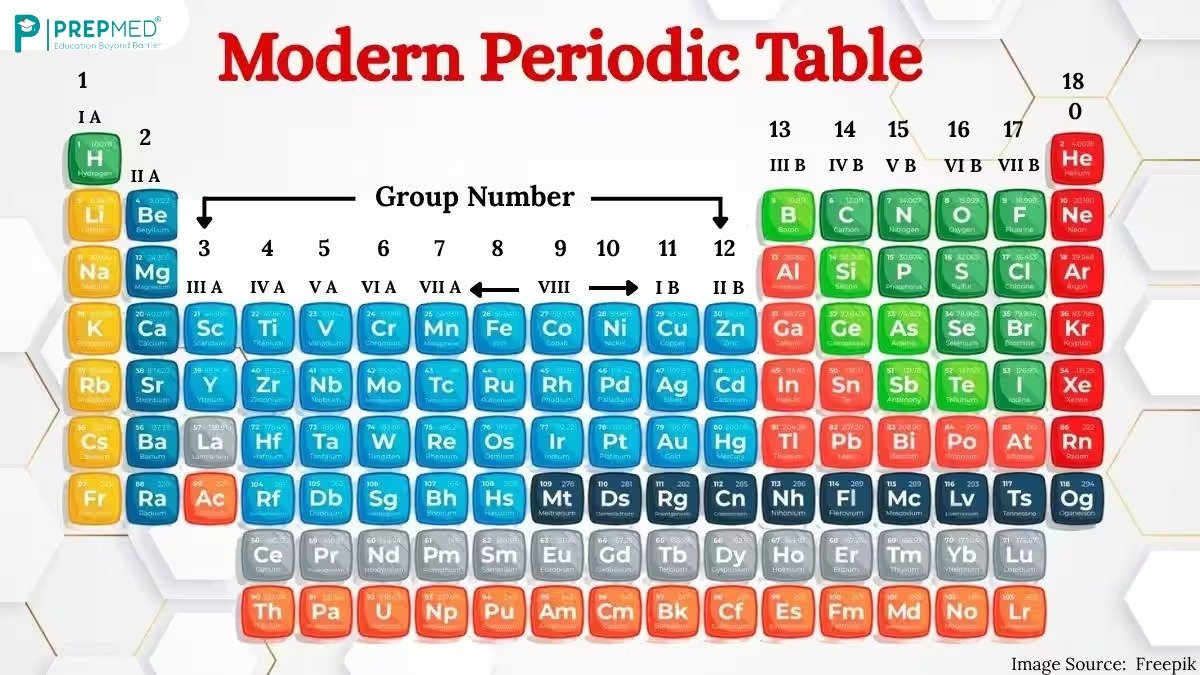
There are currently 118 confirmed chemical elements in the modern periodic table. These elements are arranged according to their atomic number, which is the number of protons in the nucleus of an atom. According to international scientific authorities such as the International Union of Pure and Applied Chemistry (IUPAC), the table has evolved over time as scientists discovered new elements and confirmed their properties.
These elements begin with Hydrogen (atomic number 1) and go to Oganesson (atomic number 118). These elements are arranged in rows known as periods and columns known as groups, which demonstrate patterns in chemical behavior. Elements belonging to the same group have similar properties and are therefore easy to study.
Rather than remembering 118 elements individually, you begin to identify trends, such as metals at the left, non-metals at the right, and a special group of noble gases at the end.
First 30 Elements of Periodic Table
For most school and competitive exams, students need to memorize at least the first 30 elements of the periodic table thoroughly. These elements form the foundation of chemistry learning.
The first 30 elements are:
Hydrogen, Helium, Lithium, Beryllium, Boron, Carbon, Nitrogen, Oxygen, Fluorine, Neon, Sodium, Magnesium, Aluminium, Silicon, Phosphorus, Sulfur, Chlorine, Argon, Potassium, Calcium, Scandium, Titanium, Vanadium, Chromium, Manganese, Iron, Cobalt, Nickel, Copper, and Zinc.
For instance, the first thirty elements can be memorized using short phrases or rhymes like:
1. Elements 1–10 (H He Li Be B C N O F Ne)
Happy Helpers Like Being Brave, Caring Nurses Often Feed Neighbors.
2. Elements 11–20 (Na Mg Al Si P S Cl Ar K Ca)
Naughty Monkeys Always Sing; Playful Students Solve Clever Arithmetic Kindly.
3. Elements 21–30 (Sc Ti V Cr Mn Fe Co Ni Cu Zn)
Smart Tigers Value Creative Minds; Fearless Coaches Nurture Courageous Zebras.
How to Learn Periodic Table?
Learning the periodic table may seem difficult at first, but with the right techniques it can become much easier and even enjoyable. By using simple memory tricks and creative study methods, you can quickly become familiar with the elements and their patterns. For students preparing for exams or anyone trying to understand chemistry better, memorising it may feel difficult. The good news is that with a few smart techniques and some creativity, learning the periodic table can become much easier.
Here are ten useful tips that can help you remember the periodic table more effectively and build confidence in your chemistry knowledge.
1. Break the Table into Smaller Parts
It can be overwhelming to memorise all 118 elements simultaneously. Rather, divide the periodic table into smaller groups and study them one at a time. Begin with group 1- alkali metals and once you are done, move to group 2 and so on. Gradually you will be able to remember the elements easily.
2. Create Your Own Mnemonics
Mnemonics are creative short phrases that help you to remember information using the first letters of every word. For example, a silly or a funny sentence can be used to recall the sequence of elements. The more unusual or imaginative the phrase is, the easier it becomes to remember. It is usually more effective to construct your own mnemonic since it is more personal and memorable.
3. Study with Flashcards
Flashcards are an easy and effective study resource. On one side, write the symbol of the element, and on the other side, write the name, atomic number or properties of the element. Go through them frequently to strengthen your memory. There are also digital flashcard apps that allow you to revise anytime and anywhere.
4. Turn the Elements into a Song or Rap
Music helps to make memorisation a lot easier. If you put the names of the elements into a rhythm or melody, they become easier to recall. Most students memorize the periodic table as a song or rap because memorizing a song is easier due to repetition and rhythm. Composing a tune on your own can make learning fun, effective and enjoyable.
5. Learn Elements by Their Properties
The periodic table has been arranged in such a way that elements which share similar characteristics are grouped together. By learning the elements according to their properties, you can learn to understand the logic behind their positions. For instance, noble gases share similar stability while halogens are highly reactive. Recognising these patterns helps you remember them more easily.
6. Use Colours to Organise Information
Colour-coding is a great visual learning technique. Highlight different groups of elements in different colours, such as metals, non-metals, and metalloids. Visual patterns help your brain recognise and recall information faster. Creating a colourful periodic table can also make studying more engaging.
7. Use Interactive Online Tools
Many websites and apps offer interactive periodic tables and quizzes. These tools allow you to explore element properties, play learning games, and test your knowledge. Interactive learning keeps you engaged and helps reinforce information through practice. Technology can make studying the periodic table more interesting.
8. Pay Attention to Element Symbols
Some element symbols look very different from their English names, which can be confusing at first. Learning the origin of these symbols can make them easier to remember. Many symbols come from Latin words, such as sodium (Na) from natrium. Understanding these origins helps create meaningful connections in memory.
9. Practice Through Games and Quizzes
Turning learning into a game can make memorisation more enjoyable. Online quizzes and challenges help you test how well you know the elements. Competing with friends or trying to beat your own score can motivate you to practise more often. Games make studying feel less like a task and more like a challenge.
10. Review Regularly and Repeat
Consistent revision is essential for long-term memory. Spend a few minutes each day revising the elements you have learned. Techniques like spaced repetition help reinforce knowledge over time. The more frequently you revisit the information, the easier it becomes to remember it permanently.
How Many Groups Are in the Periodic Table?
The modern periodic table contains 18 vertical columns, known as groups. Each group represents a family of elements that share similar chemical properties.
For example:
- Group 1 contains alkali metals like Lithium and Sodium.
- Group 2 contains alkaline earth metals like Magnesium and Calcium.
- Group 17 includes halogens such as Fluorine and Chlorine.
- Group 18 contains noble gases like Neon and Argon.
These group similarities make it easier for students to understand chemical reactions and atomic behavior.
When learning how to memorise periodic table , recognizing these families is extremely helpful. Instead of memorizing every element individually, you remember the characteristics of entire groups.
Periodic Table Song
One of the most creative tools students use is the periodic table song. Music helps memory because rhythm and melody activate multiple parts of the brain simultaneously. That’s why many students can remember song lyrics for years but struggle with textbook lists.
When you listen to a periodic table song repeatedly, the sequence of elements becomes embedded in your memory almost subconsciously. Over time, you may find yourself recalling elements simply by remembering the tune.
Many successful aspirants credit fun techniques like songs, quizzes, and storytelling for helping them crack the challenge of how to memorise periodic table during exam preparation.
Conclusion:
When you are looking out for how to memorise periodic table , you might feel overwhelmed at first, but with the right strategies it can become much easier-and even enjoyable. Whether you rely on mnemonics, flashcards, songs, or interactive quizzes, the secret is to choose a method that suits your learning style and practice it consistently.
More importantly, learning the periodic table isn’t just about memorizing symbols and numbers. It’s about recognizing patterns, understanding how elements relate to one another, and seeing how their properties shape the world of chemistry.
FAQs:
1.Why is the periodic table important for students?
The periodic table organizes all chemical elements based on atomic number and properties. It helps students understand chemical reactions, atomic structure, and material behavior.
2.What is the easiest way to memorize the periodic table?
Using mnemonics, flashcards, visualization techniques, and songs are some of the easiest methods. Studying small groups of elements daily also improves memory.
3. How can I remember 1s, 2s, 2p, 3s, 3p?
Think of the energy levels as layers in an onion. The first level has only one sublevel (s). The second level has two sublevels (s and p), and the third level has three (s, p, and d). Every level always starts with an s orbital, and from the second level onward, a p orbital is added. Following this rule gives you the order: 1s → 2s → 2p → 3s → 3p.
Also read:
How to Study Chemistry for NEET
How to Score Full Marks in NEET Chemistry – Proven Tips
How to solve chemistry questions in NEET?
Note:
Our locations:
Kolkata (Hazra Road, Opp: Jatin Das Park), Garia, Berhampore & Sodepur.
Recent Posts

Explore the PrepMed NEET 2-Year Courses List

West Bengal GMC Round Cutoff Prediction for NEET 2026 | YouTube Live

All India Quota Medical College List 2026: MBBS Course

List of MBBS Colleges in Jharkhand: Seats and Process

NEET for the Economically Weaker Section (EWS)