
How to Manage Time for Study and Improve Productivity?
Managing time for studies is not only about dividing hours, but creating a life where studying makes sense and productivity flows naturally. Every aspirant, who is either preparing for competitive exams or trying to achieve a certain academic goal, often asks how to manage time for study without feeling overloaded. Time is the only precious resource that you cannot get back and knowing how to use it wisely becomes your greatest competitive advantage. What follows is a realistic, inspirational, experience-shaped guide that pulls you out of the confusion and gives you clarity. So let’s start this journey toward discipline and significant advancement.
How to Manage Time for Study Daily?
The question of how to manage time for study daily becomes essential when you have to combine classes, assignments, coaching, and self study. Daily time management is not about stuffing your schedule with as many activities as you can; it's about choosing the things that matter the most and showing up consistently. A daily routine that is designed well gives your mind to relax in between the study hours and therefore helps you to stay focused for a longer time. When you have fixed study hours, your performance and productivity increases and the distractions reduce automatically.
A good daily study plan must include fixed study sessions with sufficient breaks in between, separate slots for revision and practice. By practicing this consistently, you will automatically become more productive, confident and have clarity in your mind. Every day becomes a small victory—bringing you closer to your bigger goal while keeping your mind energized and stress-free.
Daily Time-Management Tips:
- Wake up at the same time everyday: Consistency makes you disciplined, and discipline builds productivity. Setting an alarm to start the day helps your brain in getting ready to concentrate.
- Follow the 50-10 rule: Study for 50 minutes and have a 10 minute break. This maintains your energy levels.
- Plan three priority tasks: Do not make your to-do list too big. Identify 3 highly important topics to learn, revise or practice that are most important.
- Do not multitask: Doing everything at the same time kills your productivity. Since you cannot do two things at once, focus on the single subject which you are doing.
- Go through your day at night: A quick overview will allow you to keep track of progress and plan the next day more effectively.
- Create subject-wise time blocks: Assign specific hours to specific subjects to reduce decision fatigue.
- Limit phone time: During study hours, keep your phone away or use app blockers to focus on studying.
This day to day routine gradually changes your habit patterns and this way you can learn how to manage time for study with ease and consistency.
How to Manage Time Studying for Exams?
During exam season, how to manage time studying for exams becomes more urgent because the pressure increases and the syllabus often feels unending. This is where strategic planning becomes more useful. Exams require not just time but also effective time management: revision, mock tests, and specific practice becomes necessary. The correct strategy will make you more relaxed, stay calm, allow you to cover a lot of syllabus, and memorize information longer.
During the exams, focus on high-weightage topics, revise on a daily basis and practice active recall. Study strategically, divide large chapters, mix easy and challenging topics, and evaluate your progress with exams. This organized method keeps your anxiety low and yields high results.
Exam-Time Strategies:
- Make a countdown timetable: Mark a number of remaining days and divide the topics accordingly.
- Apply active recall strategies: It facilitates faster memorization and long-term retention.
- Practice mock tests: These simulate the actual examination pressure and sharpen your accuracy.
- Combine Group chapters: Study related chapters together to achieve greater conceptual clarity.
- Revise in cycles: Revise every 1 day, 1 week, 1 month to ensure the maximum retention.
- Avoid cramming at the last minute: This makes it more stressful and reduces the ability to remember.
- Concentrate on areas of weakness: Work on areas that you are weak in rather than avoiding them.
The practice makes it easier to know how to manage time for study during tight examination schedules.
How to Manage Your Study Time?
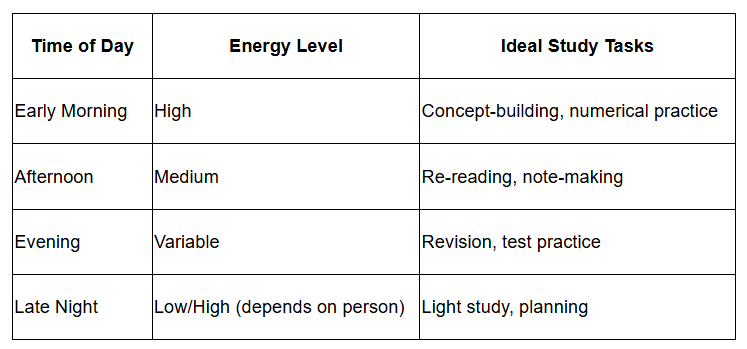
Learning how to manage your study time is a matter of matching your goals, timetable, and energy levels. Time is not just about minutes-it is about maintaining mental strength and emotional stability throughout. To make the most of your study time, it is important to understand when you study best, create a study-friendly environment, and to use study time management tools, such as planners or digital calendars. Rather than chasing hours, chase efficiency.
Below is a simple table to help you analyze your peak productivity slots:
How to Concentrate on Studies for Long Hours?
It is also important to know how to focus on studies for long hours in today’s modern world that is full of distractions.Concentration is less about forcing yourself to sit longer and more about making your environment and mindset study-friendly. The first step is to eliminate the distractions of the digital world, learn in a clean and tidy space, and have shorter breaks. Apply techniques such as the Pomodoro method, active reading, and spaced repetition. Also, drink a lot of water, sleep well, and take healthy meals before studying. Long hours of studying become much more achievable when your body feels light and your surrounding environment feels calm.
This focus practice also enriches your ability to understand how to manage time for study more effectively in the long run.
How to Study Effectively?
The art of how to study effectively lies in understanding what works with you. Each individual has a different way of learning- some learn by just watching lectures, some by reading notes, and some through teaching others. Effective study is about using techniques that match your learning style. Divide long chapters into small segments, understand the concepts before memorizing, and revise repetitively. When you study effectively, even short study sessions give you outstanding results.
Effective Study Techniques:
- Use spaced repetition technique: Revising the same topics frequently enhances memory.
- Be a teacher: As you explain a topic orally, you learn better.
- Include visual tools: Flowcharts, colors, and diagrams enhance memory.
- Practice Self testing: Test yourself at the end of each chapter.
- Keep notes concise: Brief notes ensure faster revision and greater clarity.
- Learn: Do not read passively; ask questions, analyze concepts.
- Mix subjects: Studying various subjects throughout the day keeps your mind fresh.
By applying these techniques, your ability to understand how to manage time for study becomes sharper and more rewarding.
Conclusion:
Mastering how to manage time for study is not just a skill—it’s a habit that transforms your academic journey. With smart planning, consistent routines, focused effort, and self-discipline, you will see an incredible rise in your productivity. Remember, even small daily improvements can lead to massive long-term success. Stay disciplined, stay motivated, and keep moving forward.
FAQs:
1. How many hours should a student study daily?
Most students benefit from 3–6 focused study hours a day, whereas some students need 10–12 hours. However, this depends on goals and exam difficulty.
2. How can I avoid distractions while studying?
Keep your phone away, study in a no-distraction place, follow the time slots, and take a 10-minute break after every 1 hour of studying. This keeps your mind fresh and balances your energy level.
3. What is the best time of the day to study?
Morning hours are great for learning concepts, while evenings work well for revision and practice.
Also read:
How to memorise fast and effectively?
Recent Posts

Explore the PrepMed NEET 2-Year Courses List

West Bengal GMC Round Cutoff Prediction for NEET 2026 | YouTube Live

All India Quota Medical College List 2026: MBBS Course

List of MBBS Colleges in Jharkhand: Seats and Process

NEET for the Economically Weaker Section (EWS)