How to get admission in BDS through NEET?
Having the dream of becoming a dentist is more than just picking a career, it’s rather choosing a life filled with compassion, care and service. For thousands of applicants, understanding how to get admission in BDS through NEET becomes the turning point toward this dream.
The BDS Admission through NEET is under the control of the National Testing Agency (NTA), which organizes the exam once every year. Qualifying for the NEET exam with the respective marks and rank is necessary for every student wishing to pursue dental courses such as the BDS in India. It does not matter whether you want to join a central university, a state quota, or a private dental college; having a NEET score is mandatory.
Lakhs of students appear in NEET every year with the aim of securing admission in BDS. The number of seats in BDS is limited, and thus students have to score well in NEET to get selected. The NEET-based BDS admission is not only for government colleges alone but also applies to private and deemed universities.
Let’s begin your journey to becoming a dental surgeon.
How to Do BDS?
Students who ask questions like how to do BDS tend to believe that the process is complex. But, when you get the flow, it becomes easier. The Bachelor of Dental Surgery (BDS) is an professional undergraduate course that prepares you in oral healthcare, diagnosis, and dental treatments. Whether you're planning right after Class 12 or aiming to switch paths, knowing how to get admission in BDS early helps you stay focused.
Once you crack NEET, enroll in counselling, lock your preferred college, and complete verification, then there comes your BDS life. Understanding how to get admission in BDS means understanding every step-entry, course structure, internships, and future opportunities. Here’s a detailed, reader-friendly breakdown.
Guide on how to pursue BDS:
- BDS is a 5 year course, including one year mandatory internship, providing you with the skills to diagnose and treat dental ailments with precision.
- The first thing you need to do is to qualify NEET and get the score required for admission in BDS.
- The course will cover such subjects as General Anatomy, Physiology, Oral Pathology, Conservative Dentistry, etc thus providing you with solid foundational knowledge.
- Once you receive your NEET rank, you can go through centralized counselling- AIQ, state quota or private college counselling.
- Select a college according to infrastructure, clinical exposure, fees, and patient flow-these factors matter more than many students realize.
- In BDS, students get to practice hands-on procedures under the guidance of the faculty, thus moulding them into professional dentists.
- Once you have completed BDS, you may opt for government jobs, private clinics, MDS specialization, hospital placements or research roles.
- If you’re determined to know how to get admission in BDS, remember this: the journey requires discipline, clarity, and early preparation.
How Many Marks to Score in NEET for BDS?
If you are wondering how many marks to score in NEET for BDS, it is important to keep in mind that cutoffs change every year, however, there is always a safe range. Competition for the BDS seats is relatively lower than the MBBS but the competition is still intense. Students who clearly understand how to get admission in BDS usually aim high instead of relying on borderline scores.
The average safe target for government BDS seats is usually around 500-580 marks, but the private colleges can provide admission even on low scores. But your goal should always be scoring as much as possible—because higher marks mean better college options, lower fees, and better exposure.
Let’s have a look on the marks range required in NEET for BDS:
- If you are aiming for the best government dental colleges, aim for 550+ or above.
- State quotas can differ widely - there are states where they offer government seats at 480-520 mark, depending on competition.
- In case of private and deemed universities, qualifying NEET (around 300-400 marks) may still fetch you a seat.
- Reservation categories alter cutoffs- OBC/SC/ST aspirants might get government seats at slightly lower marks.
- AIR Rank is as important as marks; the better the rank, opportunities of better placements are high.
- If you truly want to master how to get admission in BDS, don’t settle for “minimum”—aim for excellence.
How to Do BDS After 12th?
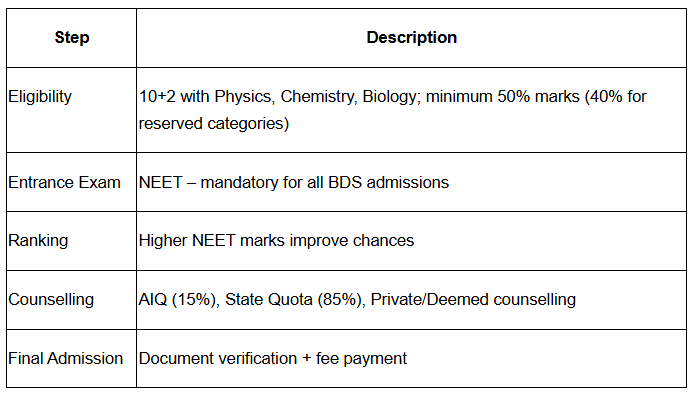
Students often ask about how to do BDS after 12th, particularly when they are exploring other medical options beyond MBBS. The procedure is simple: pass Class 12 with PCB, appear in NEET, pass the cut off, undergo counselling and get a seat in BDS. When you are motivated and understand how to get admission in BDS, then, the process becomes less overwhelming.
The following is a simple table to help you visualize the process:
Minimum Marks for BDS in NEET
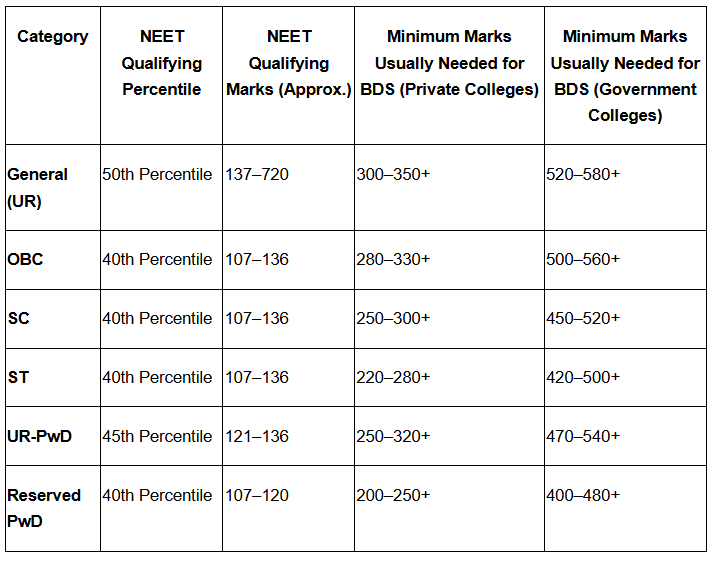
Talking about minimum marks for BDS in NEET, it should be kept in mind that minimum does not always mean sufficient. While NEET qualifying marks may go as low as 137-720 for the general category (and even lower for reserved categories), real admission cutoffs differ widely. Students who are seriously determined to know how to get admission on BDS, aim well beyond the qualifying range to secure safer options.
In general, the minimum marks required in NEET for BDS in private colleges may be around 300-350, however, in government colleges, much higher marks are required. Nevertheless, you should always strive to achieve more, and your future college life depends on your score.
How to Crack NEET Exam?
Understanding how to crack NEET exam is crucial if you genuinely want to know how to get admission in BDS without stress. NEET is challenging, but not impossible. With proper strategy, consistency, and a growth mindset, you can turn this dream into reality.
Start early, build strong conceptual clarity, practice MCQs daily, and solve previous papers. Staying consistent is more important than studying excessively for a few days.
Guide on how to crack the exam successfully:
- Build a strong foundation in NCERT, especially Biology—most questions come directly from NCERT.
- Create a realistic, flexible study timetable that includes revision, practice, and mock tests.
- Take mock tests weekly and analyze your mistakes; self-analysis is the real game changer.
- Maintain handwritten notes for last-minute revisions; they speed up retention.
- Focus on high-yield topics-Genetics, Ecology, Thermodynamics, Organic Chemistry basics, Human Physiology.
- Surround yourself with supportive competitors and mentors to keep your motivation alive.
Conclusion:
Your journey to understanding how to get admission in BDS is not just about marks—it’s about self-belief, discipline, and passion for healing. Dentistry is a rewarding profession, and the path begins with one decision: to give your best. You now know the marks, strategy, eligibility, and every essential step. Keep pushing, keep practicing, and remember—your dream seat is waiting for you. Stay confident, stay consistent.
FAQs:
1. Is NEET mandatory for BDS admission?
Yes, NEET is absolutely mandatory. It is the only entrance exam that decides your admission in BDS in India.
2. Can I get BDS with low marks in NEET?
Yes, you can still get BDS in private colleges with lower marks, but government seats require higher scores.
3. How many attempts do I have in NEET to get into BDS?
NEET has no attempt limit, so you can appear for the exam as many times as you prefer.
Also read:
Recent Posts

Explore the PrepMed NEET 2-Year Courses List

West Bengal GMC Round Cutoff Prediction for NEET 2026 | YouTube Live

All India Quota Medical College List 2026: MBBS Course

List of MBBS Colleges in Jharkhand: Seats and Process

NEET for the Economically Weaker Section (EWS)