Forgetting in the Exam Hall? Best RECALL Tips for NEET 2026! By Dr. Debajyoti Kar
By Dr. Debajyoti | PrepMed NEET | Live Session — April 22, 2026
Your Brain Hasn't Failed You — You Just Haven't Trained It Right: A NEET 2026 Recall Guide.
As the NEET 2026 approaches, there is one worry that is on the mind of each aspirant.
What will happen if I forget everything as I enter the exam hall?
Watch the original live session here: Forgetting in Exam Hall? 😱 Best RECALL Tips for NEET 2026! | Master Active Recall & Beat Exam Stress
In this live session with high energy, Dr. Debajyoti at PrepMed NEET addressed precisely that: the most prevalent and debilitating issue that students have during the final stretch. He responded to actual questions posted by students. He outlined a clear, medically sound, and practically tested plan of beating forgetting, handling exam stress and going to the hall with full confidence.
Hereby is all that he said, condensed for you.
1. How to Stop Panic Before It Starts
Dr. Debajyoti started by asking a question to one of the students: “Is there any exercise or technique to avoid panic and stress in the exam hall?
He was straightforward in his response. Two techniques work:
Deep Breathing (Deep Inhalation): Long, slow and deep breathing is a physical process that will calm your heartbeat. This is no motivational counsel; it is biology. By taking a deep breath, your parasympathetic nervous system is activated, and your stress levels are reduced.
Jaw Relaxation: When we are in a tense state, we clench our jaws without realizing it. Deep breathing with conscious relaxation of the jaw is a strong message to the brain to reduce its level of alertness.
These two methods, deep inhalation and jaw relaxation, can have a significant effect in causing levels of panic and stress to be minimized during the exam.
However, there is something even greater than the stress itself: the fact that you are telling yourself that you are panicking. It was here that Dr. Debajyoti was emphatic. The majority of the students are sitting in the examination hall and repeating to themselves, I am panicking, I am panicking. That self-talk complicates it all. Stop it immediately.
Rather, remember: Stress is natural. All the students in that room are stressed, including the toppers. The distinction is that toppers cope with that stress. They do not kill it, they labor over it. And so can you.
2. When to Skip a Question — and Why That Is Smart Strategy
One of the students questioned: Sir, when shall I skip a question?
The only rule that Dr. Debajyoti offers is to spend 30 to 40 seconds on a question and then move on. You need not look at the clock-- you will know it all by a natural reading.
However, this is where most students go wrong: not attending classes does not mean giving up. As soon as your subconscious mind has taken in a question, one you might not have known the answer to, it continues to work on it in the background. When you have gone through 10 to 15 other questions, chances are high that the answer to the earlier question that you had skipped will come to you. Your signal to have another go at it.
It is referred to as Multi-Round Attempting, and toppers apply it regularly.
- Multi-round attempts are very beneficial in Physics and Chemistry. Look through the paper, doing the simple questions first, then going back to the difficult ones.
- Multi-round attempting is not very applicable in Biology, due to the tighter time constraint, but it can still be useful in multi-framed or assertion-reason type questions that are better approached with more care in reading.
It is a wonderful comparison made by Dr. Debajyoti: "As a driver slows down at a speed breaker, and then gains speed again, so do you, when you come to a difficult question, pass it, and then get going again.
3. Association Technique — The Right Way to Recall
Among the best tips in the whole session was on how to remember something that one has forgotten in the exam hall.
Random memory search is not effective, said Dr. Debajyoti. You will never find an answer, sitting there, desperately trying to draw an answer out of your brain, at random.
Rather, apply the Association Technique. When you read a question, and you can not remember the answer, ask yourself:
- Was there something that my teacher said?
- In what chapter or section of the NCERT had something of this sort been written?
- What is the equivalent concept, formula, unit or topic to which this is reminiscent?
The answer comes naturally by establishing a chain of associations, a mental path. That is the working of memory.
In the case of Biology, in particular, Dr. Debajyoti was quite forewarned: Do not attempt to learn by heart NCERT lines at random. Several students tend to panic when they cannot recall a word-by-word sentence in the textbook. But NEET, particularly in recent years, has been moving towards concept questions, rather than line-by-line reproduction. It is much better to know the idea behind each choice than to know by heart the sentences. Then discard the strain to remember word-for-word NCERT phrasing. Reason and the facts will be presented.
4. Active Recall — The Daily Practice That Changes Everything
During these last 10 days at home, Active Recall is a habit which Dr. Debajyoti strongly recommended.
What is this? You can also try to think about a subject by yourself and close your book rather than re-read your notes passively. Take, as an example, Apomixis. Ask yourself:
- What is Apomixis?
- Does fertilisation occur?
- Is it meiosis or mitosis?
- What is the way gametes are formed?
This is a self-questioning, non-note-reading activity, which is an active recall. It is uncomfortable - and this discomfort is the thing. It also trains your brain to recall information when you are under pressure, which is what the exam hall will expect you to do.
The way to practise it: Find 15-30 minutes in the day at some point: it could be in the morning, afternoon, or night. Choose a topic, envision yourself as a teacher, and attempt to come up with five sentences about that topic without writing it down.
Toppers apply this technique to all batches, and NEET 2026 toppers would be interviewed post results by Dr. Debajyoti, to ensure which techniques had the greatest impact.
5. Do Not Re-Read Questions Repeatedly
Dr. Debajyoti identified a very popular time-wasting behavior: re-reading (rereading) questions several times.
Students often repeat a question two or three times when they are unsure, starting with Biology. During the initial 30 minutes, they are only able to attempt 30 questions instead of 40-50 questions. This brings about a time crisis towards the second part of the paper, and it raises anxiety to a high level.
The solution: Train yourself to spot the most important aspects of a question the first time you read it, practising at home. Highlight or keep in mind the significant lines, so that you will not have to read them once more. Create this as a routine throughout the 10 days. The aim is to walk into the exam hall already connected to be read and proceed.
Re-reading is not only a waste of time, but it is also a source of anxiety. Each re-read sends a signal to your brain that you are in doubt, and this intensifies the stress response.
6. Sleep Is Non-Negotiable
Dr. Debajyoti was adamant: you cannot work without sleep, and your brain cannot work. There is no cramming at the last minute that can be used to substitute for a sleep-deprived mind.
His recommendation towards the last 10 days: maintain a rigid sleep schedule. When eating is over, there is an inherent period of sleepiness, normally between 10 PM and 11 PM, as the blood circulation is switched to digestion and not the brain. Use that window. Sleep then. Alarm, wake up, and get up by 7 AM and start your day off fresh.
Fighting that natural sleeping time and going to bed at 1 or 2 AM, you will wake up tired, and spend the whole day waiting to go to bed, and all the things you read will seem out of place. It is precisely that detached learning that leads to forgetting in the exam hall.
7. Mindset: Score vs. Correct Questions
Dr. Debajyoti provided a mindset change, which most students required to hear, towards the end of the session.
Don’t worry about your overall score. Begin the questioning: "What is it that I have to get right in the number of questions?
Assuming that your Biology score is 280 and you require 330, it does not mean 50 marks; it means 12 more answers to get. What are those 12 topics? Look at your mock test papers, identify all the questions you have a minus one or zero on and create a list of those micro-topics and study only those. Time is limited. Pass through the gaps, and not over the solid ground.
His final word was one of assurance: "It is the student who brings his confidence to the exam hall that will get the rank. It is the student who leaves his confidence at home that loses before he even begins.
Watch the original live session here: Forgetting in Exam Hall? 😱 Best RECALL Tips for NEET 2026! | Master Active Recall & Beat Exam Stress
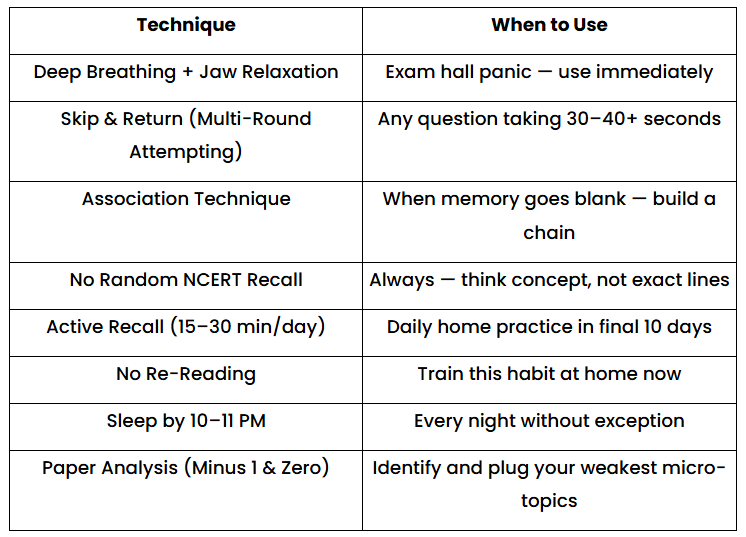
Quick Summary: Dr. Debajyoti's NEET 2026 Recall Toolkit
PrepMed NEET is a medical school operated by physicians and NEET professionals and provides online and offline courses.
Questions and tips, add to the Telegram channel: PrepMed NEET by Dr. Debajyoti.
To apply and ask questions, go to PrepMed.in. WhatsApp: 9330577737.
Also read:
How to memorise fast and effectively?
How many hours a student should sleep
3 secret study tips to become topper
Note:
Our locations:
Kolkata (Hazra Road, Opp: Jatin Das Park), Garia, Berhampore & Sodepur.
Check out here : https://centre.prepmed.in/
Recent Posts

Explore the PrepMed NEET 2-Year Courses List

West Bengal GMC Round Cutoff Prediction for NEET 2026 | YouTube Live

All India Quota Medical College List 2026: MBBS Course

List of MBBS Colleges in Jharkhand: Seats and Process

NEET for the Economically Weaker Section (EWS)