Bachelor of Siddha Medicine and Surgery (BSMS) - An Overview
If you have always been attracted to the traditional healing treatments, natural medicine, and the philosophy of ancient Indian medicine, then a Bachelor of Siddha Medicine and Surgery might be the best career for your future. This course is based on one of the oldest medical systems in India—it is not just a degree, it’s a journey into holistic healing.
Siddha medicine, which originated in South India, is founded on the philosophy of harmony between body, mind, and spirit. It does not just treat symptoms; it treats the individual.
Are you considering your decision of pursuing Bachelor of Siddha Medicine and Surgery? Well, then let’s look into all the questions you may be having, like what the eligibility criteria to pursue the course, the syllabus, salary scope, and top colleges across the country.
BSMS full form in medical
BSMS is an abbreviation of Bachelor of Siddha Medicine and Surgery. It is a UG degree under the AYUSH system of medicine, which is regulated by the National Commission for Indian System of Medicine (NCISM). This course trains students in Siddha medicine, which is among one of the oldest Indian traditional medical systems and it is believed to have been developed by ancient Siddhars.
What is BSMS?
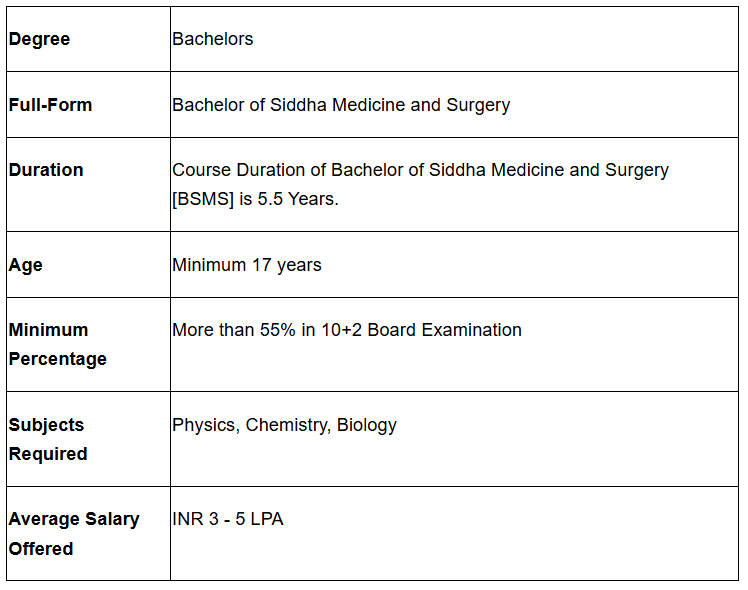
The Bachelor of Siddha Medicine and Surgery is a course with a duration of five and a half years which also includes one year mandatory rotatory internship. Students learn the foundational concepts of Siddha including the three humors ( Vatha, Pitha, Kapha ), body constitution analysis, pulse diagnosis, and pharmacology of herbs in the course.
BSMS course details
The initial years mainly focus on subjects such as anatomy, physiology, biochemistry, and basics of Siddha. As they progress, students explore pathology, microbiology, forensic medicine, toxicology and pharmacology. The last phase is clinically intensive, where topics such as general medicine, pediatrics, obstetrics and gynecology, and surgery are taught from both Siddha and modern perspectives.Let’s have a detailed look on the BSMS course details:
BSMS syllabus
The BSMS curriculum is well structured to balance between the traditional and modern subjects. The Bachelor of Siddha medicine and Surgery course covers classical siddha literature, Gunapadam (pharmacology), Noi Nadal (pathology and diagnosis) and Maruthuvam (general medicine).
BSMS syllabus in the first professional:
- Regional Language
- Communicative English
- Siddha Maruthuva Adippadai Thathuvangalum Varalarum
- Uyir Vedhiyal (Bio-Chemistry)
- Maruthuva Thavaraiyal (Medicinal Botany And Pharmacognosy)
- Nunnuyiriyal (Microbiology)
BSMS syllabus in second year:
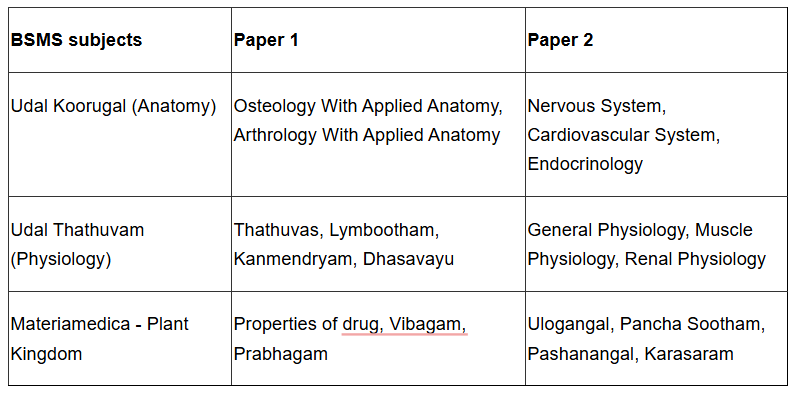
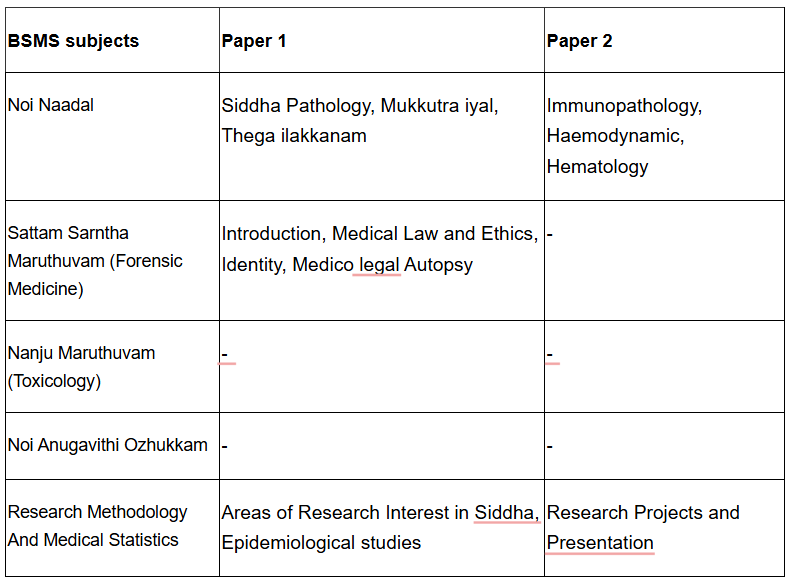
- Noi Anugaa Vidhi Ozhukkam
- Noi Naadal Noi Mudhal Nadal
- Nanju Nool and Maruthuva Neethi Nool
BSMS course eligibility
It is necessary to know the BSMS course eligibility criteria once you have already made up your mind to pursue the course.
- Admission into BSMS requires candidates to have completed 10+2 with Physics, Chemistry, and Biology as core subjects.
- Students are expected to have the minimum percentage requirements set by the regulatory authorities which tends to vary between 40-50% depending on category.
- Candidates must be at least 17 years of age during the time of admission.
- Nationality: Indian citizens, NRIs, OCIs, PIOs, foreign nationals also eligible for AIQ seats.
- Attempts: Unlimited (no cap on number of attempts).
And above all, Is NEET required for BSMS? Yes. In India, qualifying NEET (National Eligibility cum Entrance Test) is required to join the government and the private BSMS colleges. Admission is generally determined by NEET scores, which is then followed by state or central counseling.
BSMS course duration
The BSMS course duration is 5.5 years comprising 4.5 years of academics and a 1-year mandatory internship period. This period guarantees that students receive extensive theoretical training as well as clinical training.
Students work in Siddha hospitals and healthcare centers during the internship period under the mentorship of the experienced practitioners. They gain exposure to patient diagnosis, preparation of herbal drugs, herbal therapy procedures and handling of emergencies.
BSMS course fees
The fees of the BSMS course vary depending on the type of college, whether it is government or private. Fees in government colleges are relatively cheap and can be between ₹ 50,000 and ₹ 75,000 per year. On the other hand, the fees of private colleges can range between ₹ 1.5 lakh and ₹ 3 lakh per annum.
BSMS colleges
There are many good BSMS colleges in India, particularly in Tamil Nadu where Siddha medicine has deep historical roots. These institutions are recognized by the Ministry of AYUSH and affiliated with state medical universities.
Some prominent BSMS colleges in India include:
- Government Siddha Medical College, Chennai
- National Institute of Siddha, Chennai
- Dr. MGR Medical University, Chennai
- Sri Sai Ram Siddha Medical College, Chennai
- Sivaraj Siddha Medical College, Salem
- Velumailu Siddha Medical College and Hospital, Sriperumbudur
- Santhigiri Siddha Medical College, Thrissur
- Nandha Siddha Medical College and Hospital, Coimbatore
- Indra Ganesan Institutions, Chennai
- Madhya Pradesh Medical Science University, Jabalpur
- Kerala University of Health Sciences, Thrissur
BSMS scope and salary in India
There are several sectors and Organizations where one can find BSMS Job opportunities. The increase in the significance of Ayurveda over the past couple of years is phenomenal. Healthcare, medical, diet planning, teaching, drug manufacturing, and more are some of the various esteemed organizations that offer BSMS Jobs.
BSMS graduates will have employment opportunities both in the government and private sector. The National Ayush Mission, National Rural Health Mission, public hospitals, Drug control departments, etc, are the Top Government organizations providing BSMS job roles. Students after completing BSMS can pursue higher studies like MSc, M.Phil, PhD.
The average salary of a BSMS graduate in India is typically between Rs 3 lakh and Rs 5 lakh annually. Salary depends on experience, expertise, location, and workplace. With growing demand for alternative medicine, income potential can increase over time.
BAMS vs BSMS
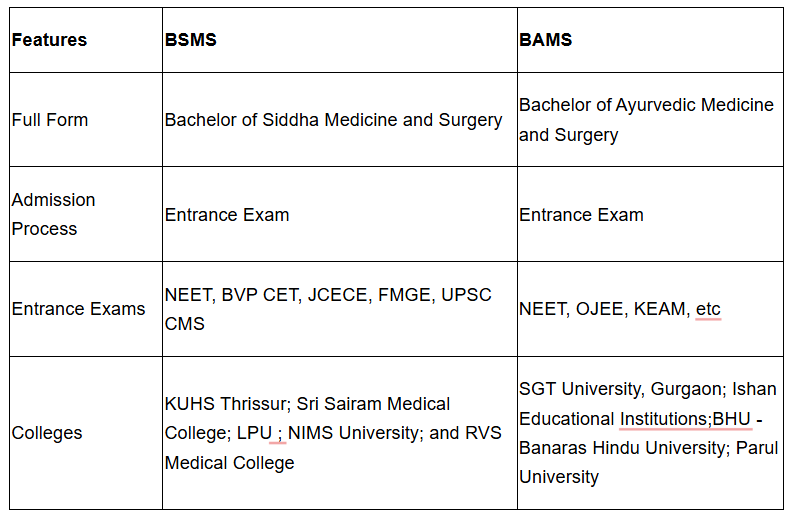
A common confusion among aspirants is BAMS vs BSMS. While BAMS (Bachelor of Ayurvedic Medicine and Surgery) focuses on Ayurveda, Bachelor of Siddha Medicine and Surgery focuses on Siddha, primarily practiced in South India.
Both courses fall under AYUSH and share similarities in structure and duration. However, the philosophical foundations, classical texts, and medicinal preparations differ. Siddha medicine places strong emphasis on mineral-based formulations and pulse diagnosis, while Ayurveda emphasizes Panchakarma and herbal therapies.
Conclusion:
Choosing a career is never just about earning a degree—it’s about making a vital decision for your future. If you feel inspired by ancient wisdom, holistic healing, and patient-centered care, then a Bachelor of Siddha Medicine and Surgery could be your gateway to a meaningful profession.
This course doesn’t merely train you to prescribe medicine; it teaches you to understand human life in its entirety. From mastering classical Siddha texts to gaining clinical expertise, the journey is transformative. With increasing acceptance of alternative medicine and strong government support for AYUSH systems, the future looks promising.
At PrepMed, we’re committed to walking this journey with you helping you unlock AYUSH seats and build a strong, fulfilling career.
Enroll now or call +91 9330577737 or drop a mail at TM@prepmed.in
Let’s convert your NEET efforts into success!
FAQs:
1. Is NEET required for BSMS?
Yes, qualifying for NEET is mandatory for admission into most government and private BSMS colleges in India.
2. Can BSMS doctors practice modern medicine?
BSMS graduates primarily practice Siddha medicine. The scope of practicing modern medicine depends on state regulations and additional certifications.
3. What is the average salary after BSMS?
Fresh graduates may earn ₹25,000–₹40,000 per month, while experienced practitioners and private clinic owners can earn substantially higher.
Also read:
How to Crack NEET in First Attempt with PrepMed?
Which is better: BAMS or BHMS?
Scope of homeopathy doctor in India
Note:
Kolkata (Hazra Rd, Opp. Jatin Das Park), Garia, Berhampore, & Sodepur.
Recent Posts
Explore the PrepMed NEET 2-Year Courses List
West Bengal GMC Round Cutoff Prediction for NEET 2026 | YouTube Live
All India Quota Medical College List 2026: MBBS Course

List of MBBS Colleges in Jharkhand: Seats and Process
NEET for the Economically Weaker Section (EWS)